Reading the Unseen Budget: Tax and Council Levies on a Three Counties Build in 2026

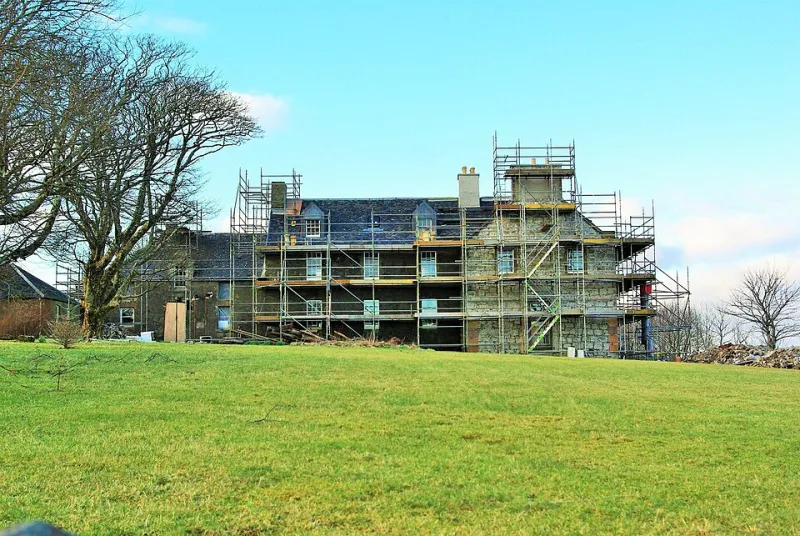
Photo: Stephen Craven , CC BY-SA 2.0, via Wikimedia Commons
Most homeowners approach a Three Counties extension or renovation with a builder's quotation in hand and a clear mental picture of the finished room. The quotation is, however, a construction document. It prices excavation, structure, finishes and perhaps design coordination. It does not, as a rule, price the statutory landscape around the work: the tax treatment of the supply, the levy a council may charge for new floor space, or the permits needed to occupy the pavement and highway. These are the quiet line items, and on a 2026 project across Gloucestershire, Herefordshire and Worcestershire they deserve a place in the budget before contracts are signed.
Start with the tax status, not the quotation
VAT is the first charge that can surprise a homeowner, because it depends on what is being built rather than what the builder calls the job. A straightforward extension to an existing dwelling is generally standard-rated at 20 per cent. A new dwelling can be zero-rated, subject to the usual conditions, while certain qualifying conversions and renovations of long-empty residential property may attract the reduced rate of 5 per cent. Repairs and maintenance are ordinarily standard-rated. A project that mixes repair, extension and conversion work therefore needs a clear apportionment rather than a single rate applied to the whole invoice.
The practical point is that VAT should appear in the budget from the outset. Ask the builder to state the VAT treatment of each element in writing, and have an accountant confirm the position before work begins. Self-builders should also examine the VAT refund scheme for DIY housebuilders, which can recover VAT on eligible materials and services, but only where the paperwork is complete and the claim is made within the permitted period. The scheme is a recovery mechanism, not a substitute for cashflow planning: the tax may still be paid up front.
Invoices matter. A valid VAT invoice should show the supplier's name, address and VAT number, the date, a description of the work and the amount of VAT charged. Keep these documents in a single project file, alongside contracts and variation statements. If a builder is not VAT-registered, that should be confirmed rather than assumed, and the quotation should make clear that no VAT is being charged. Where subcontractors are involved, the main contractor should explain how their invoices are handled so that the final account is not a patchwork of unexplained additions.
Community Infrastructure Levy: check before the first excavation
Community Infrastructure Levy, usually shortened to CIL, is a charge on new floor space. It is not universal. Some charging authorities adopt a CIL schedule and some do not, and the rates and instalment policies can differ between neighbouring districts. A homeowner in one part of the Three Counties may face a CIL liability on an extension or conversion, while a similar project a few miles away may not. The only reliable starting point is the charging authority's published schedule, checked against the specific plans and the gross internal area involved.
Self-build housing can qualify for an exemption, and residential annexes may also be exempt in certain circumstances, but the relief is not automatic. The liable party normally needs to assume liability and submit the relevant exemption claim before commencement, followed by a commencement notice. Starting work without the correct forms can remove the benefit or create surcharges, and retrospective claims are not a safe assumption. Where CIL applies, the charge should be treated as a project cost with its own cashflow date, not as a distant administrative matter.
Council fees and permits accumulate quietly
Planning fees, building-control charges and highway licences are the visible edge of local authority costs; skip permits, scaffold licences, hoarding consents and tree-work applications are the smaller items that can still disturb a budget. Planning application fees are set within a national framework, but building-control fees and permit charges are published locally and can vary. Some projects also trigger contributions or obligations under a section 106 agreement, particularly on larger schemes or sites with specific local requirements.
The contract should state clearly who is responsible for making each application, who pays the fee and who holds the decision notice or permit. A builder may agree to manage the process without agreeing to fund it. If the homeowner is to pay, the contractor should provide the council's receipt or invoice rather than a rounded figure on the final account. Where a party wall award, highway licence or temporary access arrangement is needed, the associated professional and administrative costs belong in the same statutory allowance.
Build a separate allowance and keep it separate
A construction contingency is intended for unforeseen ground conditions, design development and minor scope changes. It is not a sensible home for VAT, CIL or council charges. Keep a distinct statutory allowance in the project budget, sized from the actual tax treatment and the published charging schedule rather than from a percentage guess. Review it when the plans are finalised, when the contract is signed and again before work starts.
The paperwork should be gathered from day one: VAT invoices, the CIL assumption and exemption forms, the commencement notice, planning decision notices, building-control applications, permit receipts and any correspondence about exemptions or reductions. These documents may be needed for a VAT refund, a CIL reconciliation or a future sale, and reconstructing them after the scaffolding has gone is far harder than filing them as they arrive.
The quiet line items are not optional extras. They are part of the true cost of building in the Three Counties in 2026. A homeowner who asks about them before signing is not being cautious for its own sake; they are making sure the budget that looks complete on paper remains complete when the final invoice arrives.